


A useful pneumatic parts RFQ checklist does two things: it makes every requested item identifiable, and it makes every unresolved detail visible. An RFQ—request for quotation—does not need to pretend that the buyer already knows everything. It does need to distinguish a confirmed specification from a question.
For a mixed pneumatic order, start with one requirement per row, an explicit quantity and unit, and a source reference whenever a model could be ambiguous. Use this pneumatic components RFQ preparation checklist to organize shared project information above the table rather than repeating it inconsistently across rows. This suggested format is designed to help a supplier prepare a comparable response; it is not a purchase order or a promise that every item can be supplied.
Pneumatic Parts RFQ Checklist: What to Include
Begin your pneumatic components RFQ preparation checklist by stating what kind of response you need. Are you asking for an exact model, allowing a documented alternative, requesting technical identification, or combining those tasks in different rows?
A pneumatic parts quotation is easier to review when the supplier can retain your own line references. Use a stable reference such as R01 rather than numbering by a spreadsheet’s temporary sorting order. If you revise the list, retain the line identity and state the new revision.
Provide these shared details once:
| Shared field | Purpose |
|---|---|
| Contact name and reply address | Identify who can resolve questions |
| Company or project reference, where applicable | Connect the discussion with the right requirement |
| Required response | Exact supply, alternative proposal, identification or a combination |
| Delivery destination when relevant | Allow delivery scope to be discussed accurately |
| Requested timing | State your target; it is not yet a supplier commitment |
| Required documents or packing | Ask explicitly rather than assuming inclusion |
| Revision reference | Make it clear which parts list supersedes the previous one |
Commercial guidance from the US International Trade Administration likewise identifies product details, quantities/values, delivery scope, payment conditions and validity as distinct information in a pro forma document.1 For an RFQ, the practical lesson is to request the fields you will need to assess later; after a supplier responds, use the pneumatic parts quotation checklist to review the received quote line by line.
One Product Requirement Per Line
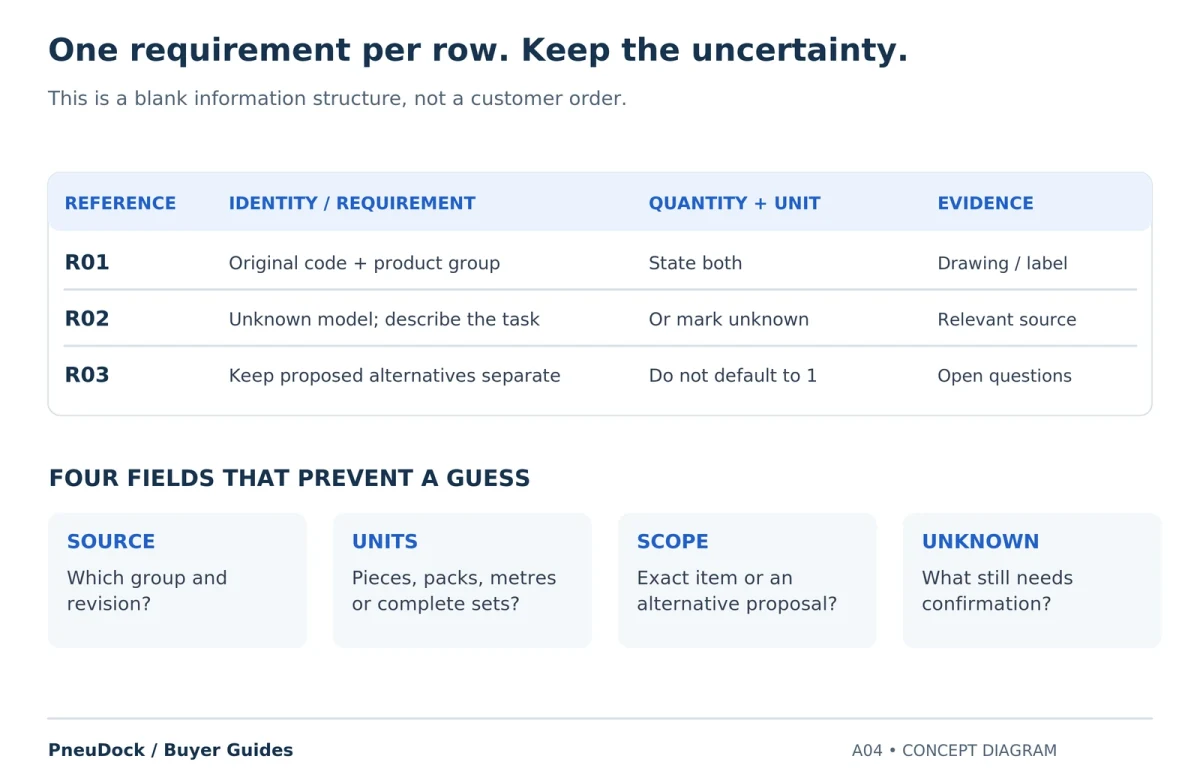
Use one row for one identifiable requirement, not one row for an entire assortment. Keep ordinary and stainless variants separate, and include the series or product group whenever the same short code can occur in more than one context.
A row may still be unresolved. “Tube-to-thread elbow; see equipment port drawing” is a legitimate identification request. A made-up complete model is not.
The following pneumatic parts list RFQ template is an illustrative format, not a real buyer request or a set of stocked PneuDock SKUs:
| Reference | Original model or requirement | Quantity and unit | Evidence | Still to confirm |
|---|---|---|---|---|
| R01 | PC group, threaded straight; complete model not yet selected | 100 pieces | Tube specification and port drawing | Exact model and thread identity |
| R02 | PMF group, female-thread bulkhead | 20 pieces | Panel-layout reference | Connection details and mounting drawing |
| R03 | Tubing: retain buyer’s original size expression | 120 metres required in total | Existing tube specification | Material, dimension meaning and pack length |
These rows show how to preserve uncertainty without losing the request. They do not authorise a supplier to choose arbitrary specifications to fill the gaps.
Pneumatic Parts RFQ Checklist Example: Four Models
A pneumatic parts list RFQ template still needs one row per selected model, even when a product page groups several models. The example below shows four different model references; it does not treat them as a bundled kit.
The following hypothetical request uses selected model references. Its quantities are invented to demonstrate the format; they are not stock levels, package quantities or minimum orders. Every connection and supply condition still needs confirmation.
| Buyer row | Complete model reference | Required connection form | Illustrative requested quantity | Key clarification |
|---|---|---|---|---|
| N01 | PCF8-02 | Female-thread straight | 120 pieces | Full mating male-thread specification and tube requirements |
| N02 | PV12 | Right-angle tube-to-tube | 80 pieces | Both tube ends and installation envelope |
| N03 | PU10 | In-line tube-to-tube | 200 pieces | Both tube specifications |
| N04 | PC8-02 | Male-thread straight | 60 pieces | Full mating female-port specification and sealing requirements |
Use the PCF series or PV series page to identify the relevant model row, then retain the full code in your list. Do not substitute “one PCF product” for an actual quantity of a named model. A mixed order also needs its own packing and delivery confirmation: it is not evidence that all listed parts fit together or that mixed quantities are automatically accepted.
Keep unknown quantity and specification fields in your pneumatic parts list RFQ template marked for confirmation. Use only the rows needed for the project, then copy the details into the site’s inquiry fields. Agree on an exchange method before sending attachments that need special handling.
Pneumatic Fitting Quantities and Units
Record pneumatic fitting quantities and units together; a number without a unit is incomplete. “50” may mean pieces, packs, metres or complete coupling sets.
Check pneumatic fitting quantities and units at three levels when relevant: the amount you need, the supplier’s packing unit and the quantity the supplier proposes to quote. Do not assume they are equal.
For a coupling pair, specify whether you need individual halves or complete matched sets. For tubing, distinguish total required length from the preferred length of each continuous piece. For example, a project requiring one uninterrupted length is not necessarily satisfied by several shorter lengths adding to the same total.
Packaging conversions should be explicit. If a supplier offers packs and your request is in pieces, ask for the pieces-per-pack value and the resulting supplied quantity. A calculation based on an unconfirmed pack size is still an assumption, even if the arithmetic is correct.
Keep requested quantity, requested unit and packaging questions in separate columns of your pneumatic parts list RFQ template. This separates the buyer’s requirement from any pack conversion the supplier later proposes.
Mark Missing Specifications
A request for quotation checklist should not hide the difference between “not requested,” “not known” and “to be confirmed by supplier.” Use those statuses deliberately.
For instance, a material grade might be irrelevant to one request, a firm buyer requirement in another, or currently unknown in a third. Writing “stainless” in every field does not resolve those different situations.
Attach only evidence that belongs to the row. Give the file a descriptive name and identify the relevant page or drawing revision. An entire catalogue without a row reference can leave the recipient unsure which table you mean. If the source uses a different model prefix, do not label it as the requested item’s drawing until the relationship is established.
Treat alternatives as a separate decision. You can state “exact match only,” “alternatives may be proposed separately,” or “identification assistance required.” A proposed substitute should identify the change; it should not silently overwrite your original model.
Pneumatic Supplier Inquiry Checklist
Run this final pneumatic supplier inquiry checklist before sending:
Identity: each row has a model with context or a sufficiently clear description. Repeated short codes include their group.
Quantity: pneumatic fitting quantities and units belong together. Mark unknown quantities explicitly rather than defaulting them to one.
Evidence: drawings, labels and photographs are associated with the correct row. File revisions are visible.
Scope: destination, requested timing, packaging and document needs are stated where they affect the response.
Uncertainty: unanswered technical questions remain questions. No guessed thread, material grade, approval or matching profile has been promoted to a requirement without your agreement.
After completing the pneumatic parts RFQ checklist, you can use this email introduction:
Please quote the attached list by our row references. Keep unidentified items and proposed alternatives separate. State any quantities, specifications, documents or delivery details that require confirmation. Please refer to this list’s revision in your response.
This is suggested buyer wording, not PneuDock’s contractual terms or a guaranteed response format.
Keep the Communication Traceable
Send only the information needed to process the request. Do not include unrelated customer records, internal passwords or confidential cost calculations in a product document. If a drawing needs special handling, establish the appropriate exchange method before sending it.
Run the pneumatic supplier inquiry checklist again whenever a row is added, a quantity is revised, a source drawing is replaced or the destination changes. Do not rely on the supplier noticing a small alteration inside a reused filename. Retaining old versions gives both parties a way to resolve discrepancies.
Buyer Questions
Can I send an RFQ without complete model numbers?
Yes. A pneumatic components RFQ preparation checklist can start with an identification request: describe the task and mating connections, provide evidence and mark the model as unresolved. A firm quotation may require those details to be settled first.
Should different product families be sent in different messages?
They can be in one clear list. Use different rows and appropriate specification fields for fittings, valves, silencers, tubing and plugs. Shared delivery information can remain at request level.
Is sending an inquiry the same as placing an order?
Use the pneumatic supplier inquiry checklist to prepare an inquiry; quotation review and order confirmation are separate steps. Confirm the actual transaction terms with the supplier before proceeding.
Take the Next Step
Browse Pneumatic Product Series to identify relevant groups, prepare your pneumatic parts RFQ checklist, and use Start Your Inquiry. Include any facts you need confirmed rather than selecting a guessed model to make the form look complete.
Sources and Scope
-
US International Trade Administration, Pro Forma Invoice. Used for the distinction among product, commercial and delivery information; the checklist and examples here are original editorial recommendations, not a legal form.
[…] and purchasing quantities into a record the recipient can answer directly. Use the published pneumatic parts RFQ checklist for a row format, keeping pneumatic tubing length units and unresolved dimensions in separate […]