


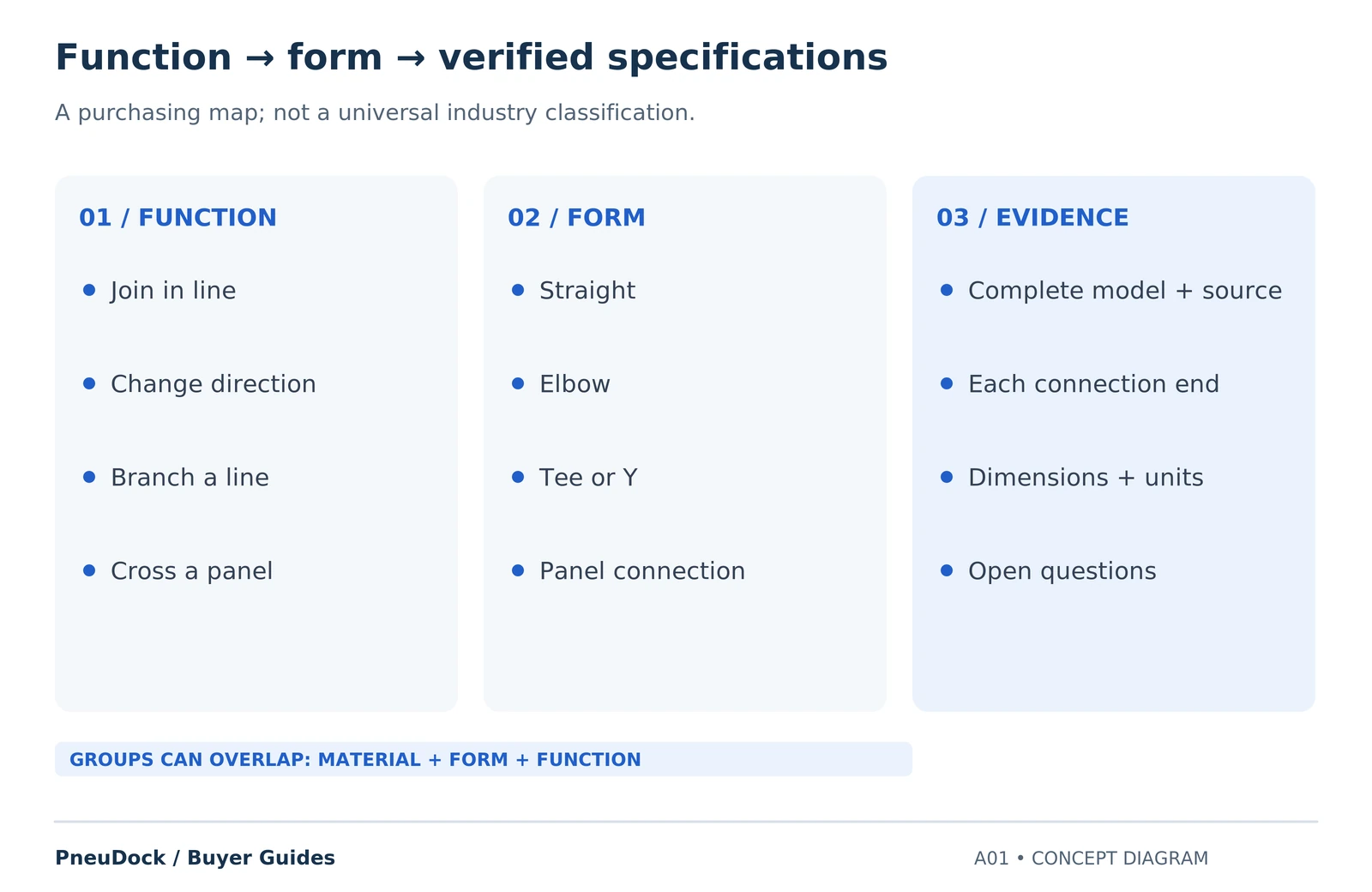
A useful way to compare air line fitting types is to ask three questions in order: what must the part do, how does each end connect, and which exact specifications apply? Starting with the shape alone can lead to the wrong inquiry. Two straight-looking parts may serve different connection methods, while a familiar model code may appear in several unrelated product groups.
This guide provides a purchasing map, not a universal classification standard or an interchangeability chart. It covers the connection groups in the PneuDock source register and explains what information a buyer should retain before requesting a quotation. Actual dimensions, materials and operating limits still belong to the selected product’s documentation.
A Practical Map of Fitting Groups
Begin with the job of the component. A tube connector joins a line; a panel-mounted connection must also accommodate the mounting arrangement. A quick-coupling pair introduces a separate mating interface. A flow-control device or exhaust silencer should not be treated as another version of a simple connector.
Manufacturer catalogues make these distinctions. For example, SMC’s KQ2 catalogue separately illustrates unions, threaded connectors, tees, bulkhead connections and plugs. Those illustrations demonstrate different functions; they do not establish equivalence between SMC models and similarly named products elsewhere.
Use the following as a buyer’s sorting checklist. The “next information” column is deliberately more important than the shape label.
| Product group | Question it helps answer | Information to retain for an inquiry |
|---|---|---|
| Tube-to-thread connector | Does a tube need to meet a threaded port? | Tube connection size; thread standard, size and gender; complete model |
| Tube-to-tube union | Are two tube ends being joined? | Size and approved tube requirements at both ends; same-size or reducing arrangement |
| Elbow, tee or Y connector | What routing or branching arrangement is needed? | Each port’s connection, orientation and size—not just the overall shape |
| Bulkhead connection | Must the connection pass through a panel? | Connection details plus the model-specific mounting drawing |
| Stainless fitting group | Is a particular material requirement part of the purchase? | Exact group, component materials and any required evidence |
| Quick-coupling group | Must two separable coupling halves be matched? | Both halves, mating profile, end connections and release requirements |
| Flow-control or manual valve | Is the task to regulate or switch the air path? | Required function, port arrangement and the relevant valve documentation |
| Silencer, tubing or plug | Is the item an exhaust component, a line or a closure? | Its own product identity and specifications, not a connector’s assumptions |
Several of these groups can overlap. A stainless bulkhead union has a material description, a mounting function and a connection form. It is not necessary to force all three into a single mutually exclusive category.
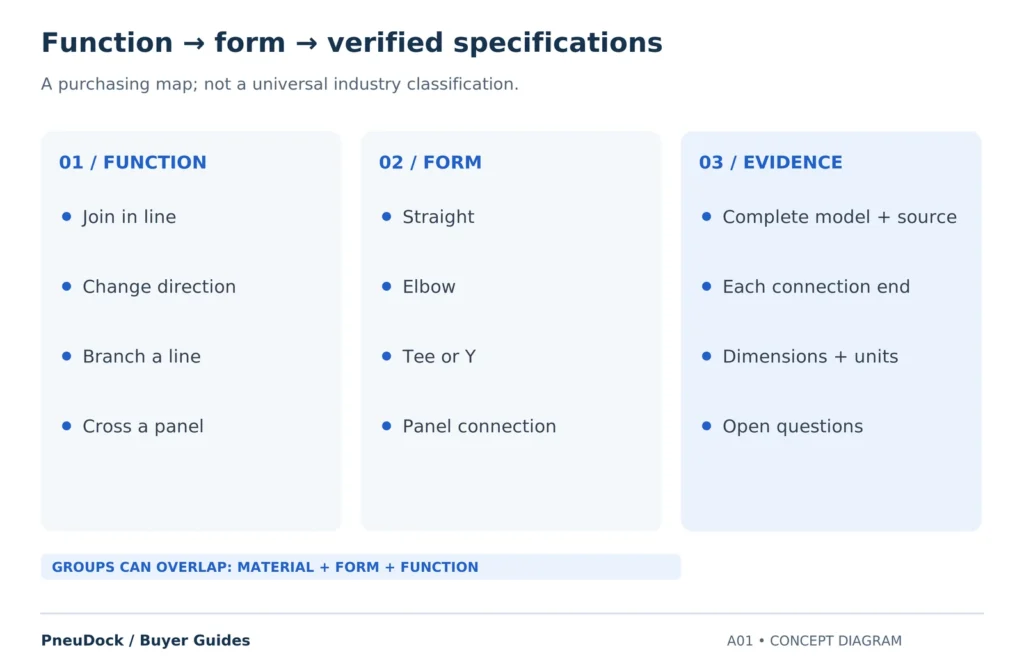
Figure 1. Identify function first, then form, then specifications. This is a conceptual navigation aid, not an engineering drawing or a compatibility statement.
Straight, Elbow, Tee and Y Forms
Among the different types of air line fittings, shape is useful shorthand—but it is only the second step.
A straight requirement should distinguish a threaded connector from a tube-to-tube union. An elbow requirement should identify both connection ends and the required routing. A tee or Y requirement needs every branch described; writing one diameter beside a three-port item may leave two ports unspecified.
In the product-group register used for this guide, PC is listed as a threaded straight group, PL as an L-shaped elbow group and PE as a T-shaped union group. These are source labels, not a claim that their ports share a standard size, material or pressure rating.
Consider this hypothetical request, which is not a stocked SKU:
“Please identify an elbow connection. One end needs to accept the tube shown in the attached supplier specification. The other end connects to the port shown in the equipment drawing. Required quantity: 40 pieces. Thread standard is not yet confirmed.”
That is a better starting point than “40 elbow fittings.” It identifies a form, both mating items, a quantity and an unresolved question without pretending that the buyer has already selected a model.
For a three-port requirement, label the branches A, B and C on a photograph or sketch. Then use one row for each connection. The labels are reference points for communication; they are not proposed manufacturer port numbers.
Apply the Map to PCF, PV, PU and PC
The four fitting series in PneuDock’s current product-content plan make the connection distinction more concrete. Use them as series and model references for an inquiry, not as proof that a particular configuration is stocked or already approved for your equipment.
| Connection you need to describe | Series reference | Example reference | Details still needed |
|---|---|---|---|
| A tube to a mating male-thread component, in line | PCF female-thread straight fittings | PCF8-02 | Tube outside diameter; complete mating-thread standard and size; sealing and space requirements |
| Two tubes meeting at a right angle | PV union elbows | PV12 | Both tube outside diameters; permitted tube specifications; installation space |
| Two tubes continuing in line | PU straight unions | PU10 | Both tube specifications and the applicable connection requirements |
| A tube to a mating female-thread port, in line | PC male-thread straight fittings | PC8-02 | Tube outside diameter; complete female-port specification; sealing arrangement |
PCF and PC differ at the threaded end. PU has no threaded equipment port in this described layout. PV and the existing PL elbow are not interchangeable names: PV describes two tube ends here, whereas PL includes a threaded connection. PCF must also remain distinct from the panel-mounting PMF group. These comparisons narrow the connection task; they do not establish compatible threads, dimensions or material grades.
A series page can list several model references. Include the full selected model on each inquiry line rather than asking for an unspecified “PCF assortment.” For example, retain PCF12-03 and PCF12-04 as two separate requests.
Tube Connections vs Quick-Coupling Groups
When reviewing pneumatic fitting types, do not assume that “quick connect” always describes the same interface. A push-in tube connection and a detachable plug-and-socket coupling can both be described with quick-connection language, yet the information needed to select them is different.
For a tube connection, the buyer needs the specified tube size and the permitted tube requirements. For a detachable coupling, there are two component identities plus a mating profile. CEJN’s compressed-air documentation explicitly distinguishes the coupling/socket from the nipple/plug and discusses pairing corresponding profiles.
Consequently, a request for “a quarter-inch quick connector” is incomplete until the dimension is assigned to something: a tube, a threaded end or a coupling-series designation. A number without a field name should remain a question, not be converted into a model selection.
What a Model Code Does Not Confirm
Model codes are valuable identifiers, but a short code is not a complete specification. The source register contains ordinary PC and stainless PC groups. It also records PM under bulkhead fittings, standard C-type couplings and self-locking C-type couplings.
For pneumatic connector types, preserve the hierarchy:
Product group → series or source designation → complete model → verified specification.
Do not remove a prefix, suffix, slash or material qualifier to make a code easier to type. Keep the original expression and place your interpretation in a separate field. A search alias can help locate a record; it must not silently replace that record’s identity.
The same caution applies to images. A photograph helps distinguish forms, but it does not certify a thread profile, alloy grade, allowable temperature or pressure. Pair the photo with the correct model sheet.
Build a Clear Inquiry
Once you have narrowed the types of pneumatic connectors, turn the choice into a short evidence-backed request. Use this checklist rather than trying to make every detail sound certain.
| Field | What to send |
|---|---|
| Required task | Join, branch, pass through a panel, disconnect, regulate or close |
| Product form | Straight, elbow, tee, Y or another documented form |
| Complete identity | Original model and source group, when known |
| Connection details | A separate description of each end |
| Quantity and unit | Pieces, packs or another explicit unit; mark unknown values |
| Supporting evidence | Relevant drawing, label photograph or current specification |
| Questions | The exact facts that still need confirmation |
A good submission can contain an unidentified item. “Model unknown; see labelled photo” is more honest than assigning the nearest-looking code. The supplier can then explain what additional information is needed.
Buyer Questions
Is an elbow fitting always interchangeable with another elbow of the same apparent size?
No interchangeability conclusion follows from appearance alone. Compare the exact connections, mounting envelope and documented specifications. Ask for confirmation when one of these is unknown.
Should every product in a parts list use the same category label?
No. Use one clear product group per line, while retaining shared project details separately. A valve, a silencer and a tube plug need different specification fields even when they belong to the same air circuit.
What should I do when I cannot name the part?
Provide its task, photographs, mating-part information and required quantity. Do not dismantle operating equipment merely to obtain a photograph; obtain information through the responsible person and the applicable safe procedure.
Take the Next Step
Use Pneumatic Product Series to select the relevant group. Then use Start Your Inquiry with the form, complete model or photograph, quantity and any unconfirmed details.
Sources and Scope
- PneuDock product-group reference notes, prepared from the supplier-group mapping. Group labels do not guarantee stock, material grade or compatibility.
- SMC KQ2 One-touch Fittings catalogue, page 2. Used for general form distinctions, not a PneuDock cross-reference.
- CEJN eSafe compressed-air coupling FAQ, questions 4–6. Manufacturer-specific descriptions do not establish compatibility for PneuDock products.
- PneuDock selected fitting-series reference for PCF, PV, PU and PC. Model references do not establish stock, thread standard, dimensions or interchangeability.

[…] pneumatic coupling pairs. For a broader overview of unions, elbows and tees, start with the air line fitting identification guide. The distinction matters: a tube pushed directly into a fitting is not the same selection problem […]