

Comparing quick-connect air fitting types requires more than matching two parts that look alike. Record the coupling half, the mating profile and the connection at the back of each half separately. Then confirm the operating requirements and release behaviour for the actual assembly.
This guide concentrates on detachable pneumatic coupling pairs. For a broader overview of unions, elbows and tees, start with the air line fitting identification guide. The distinction matters: a tube pushed directly into a fitting is not the same selection problem as a plug inserted into a separate coupling socket.
First Check: Tube Fitting or Detachable Coupling?
PCF, PV, PU and PC are the tube-fitting series in PneuDock’s current product-content plan. They are not four plug-and-socket coupling profiles. PCF and PC describe tube-to-thread arrangements, while PU and PV describe tube-to-tube arrangements in the selected scope.
For a straight tube union, review PU Straight Push-in Unions; for a right-angle tube-to-tube connection, review PV Push-in Union Elbows. A tube-port release ring must not be described as a documented vent-before-release coupling mechanism. When the requirement really is a detachable coupling pair, continue with the profile checks below and identify both halves separately. Mentioning a C-type source group in this guide does not confirm that a matching product is currently listed or supplied.
What Is Being Connected?
Describe the boundary you need to join. Is a hose being connected to a tool? Is a supply line being joined to an existing socket? Are both halves being replaced, or must one new half mate with an installed part?
These are different procurement tasks. If one installed half must remain, its exact identity becomes a constraint. If both halves may be replaced, that does not eliminate the need to specify hose or port connections, pressure limits, flow requirements and the intended disconnection procedure.
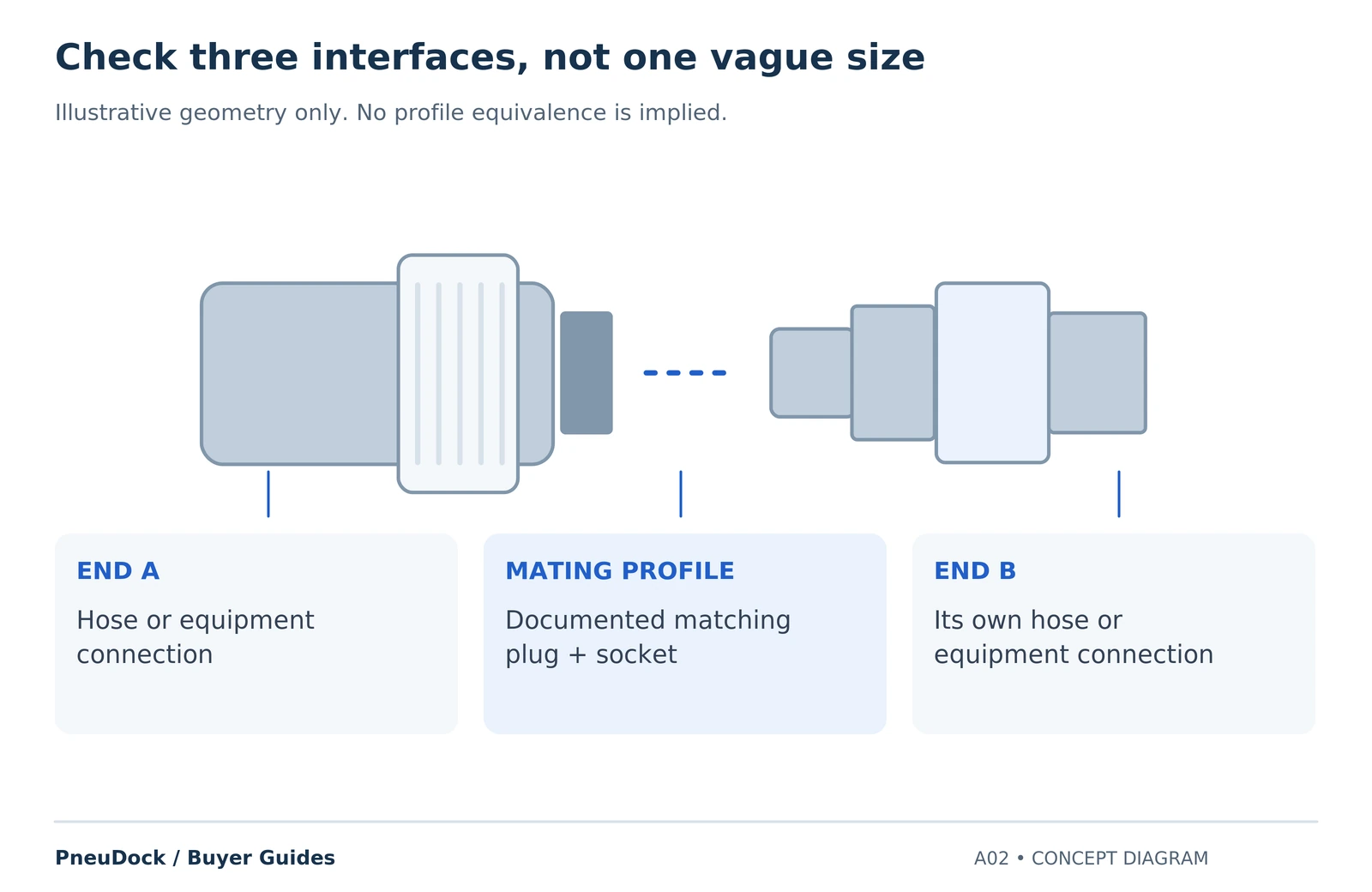
A short request such as “send a matching quick coupling” hides the most important issue: matching which interface? There is a mating interface between the halves and a different connection from each half to the hose, pipe or tool.
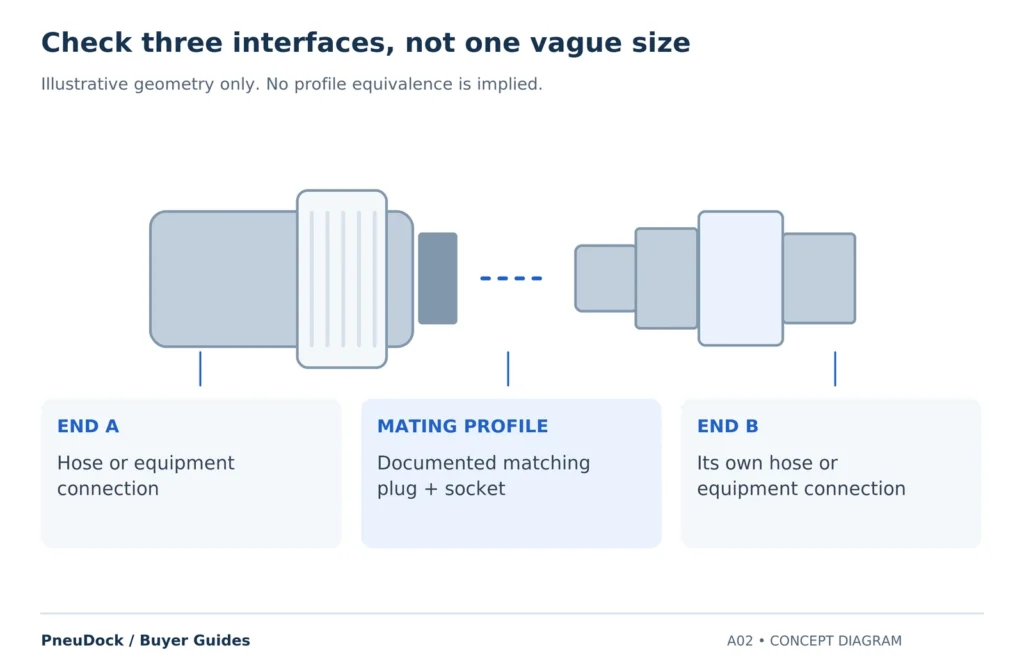
Figure 1. End connections and the mating profile are three separate checks. Shapes are schematic and do not represent an approved C-type, Euro, Japanese or other specific profile.
Separate the Plug and Socket Details
Descriptions of types of quick connect air fittings often use coupling/nipple, socket/plug or female/male coupling language. CEJN explains that the socket side may itself have either an external or internal threaded end; the plug side may also have either type of end connection.
Therefore, “male” by itself can be ambiguous. It may refer to the insert that enters the socket, or to an external thread at the opposite end.
A clearer parts-list entry has two fields:
| Field | Example of a clear description |
|---|---|
| Mating half | Socket/coupling, confirmed by the manufacturer’s drawing |
| Equipment connection | External threaded end; exact thread still to be confirmed |
This is an example of how to describe a requirement, not a completed specification. Do not use it to select a thread or coupling size.
Ask for photographs of both ends, readable markings and the relevant source document. A picture of only the hexagonal rear section cannot establish the insertion profile. Equally, a picture of the nose cannot tell you everything about the rear port connection.
Profile Information to Verify
When comparing quick-disconnect air fitting types, avoid collapsing these separate dimensions into one “size” column:
Mating profile. The geometry by which plug and socket connect. Use the manufacturer’s profile reference or drawing.
End connection. The hose or port interface on each half, including thread information when applicable.
Flow information. The relevant documented performance at stated conditions. A rear thread designation is not a complete flow specification.
CEJN’s FAQ describes regionally common profiles and advises pairing each nipple with its corresponding coupling. Its product information also lists nominal flow diameter as a separate technical field. The purchasing implication is to compare named fields, not infer one from another.
Our suggested evidence check is:
| Check | Evidence to request | What not to treat as proof |
|---|---|---|
| Existing half | Complete part number, markings and source document | “Looks like the old one” |
| Mating profile | Manufacturer-confirmed series/profile or dimensioned drawing | A generic “quick-connect” label |
| Rear connection A | Connection type and complete specification | The thread on the other half |
| Rear connection B | Its own connection information | The mating nose diameter |
| Operating requirements | Appropriate media and operating conditions | Another series’ catalogue maximum |
| Release behaviour | Model-specific instructions | “Self-locking” in a price-list heading |
This is a request checklist, not an interchangeability certification procedure. If the information is contradictory or incomplete, keep the pairing unconfirmed. Do not force components together as a substitute for identification.
Standard and Self-Locking Source Groups
The PneuDock source grouping distinguishes standard C-type and self-locking C-type entries. Both groups contain short codes such as PM and PP. The same letters therefore need the group context to remain meaningful.
Among pneumatic quick coupler types, “self-locking” should not automatically be rewritten as “vented safety,” “two-stage release” or compliance with a particular standard. Those are additional claims that require documentation for the selected product.
For contrast, CEJN expressly describes venting before disconnection for its eSafe range. This is a named manufacturer feature, not evidence that an unverified C-type group behaves the same way. PneuDock’s source labels must stand on their own supporting documents.
The safe editorial and purchasing distinction is simple:
A label identifies what to investigate. A model-specific instruction establishes how the component is intended to operate.
Do not label a source group “Euro,” “Japanese” or “universal” without confirmation. Retaining a familiar commercial label is acceptable; expanding it into an unverified interface standard is not.
Information to Send for Confirmation
Use the following template when you need to narrow the pneumatic quick connect types in a mixed list:
| Requirement | Buyer’s entry |
|---|---|
| Replace one half or both? | State the intended scope |
| Existing coupling half | Exact marking and manufacturer, or identify it as unknown |
| Requested source group | Standard C-type, self-locking C-type, or unknown |
| Complete source model | Preserve punctuation and suffixes |
| Connection at equipment side A | Describe it independently |
| Connection at equipment side B | Describe it independently |
| Available profile evidence | Drawing/reference, or “confirmation required” |
| Operating and release requirements | State the application requirements without assuming compliance |
| Quantity | Complete sets or individual halves—specify which |
That last distinction can change the whole inquiry. “20 couplings” might mean 20 sockets or 20 complete pairs. Write “20 complete matched sets” only when that is what you want; otherwise identify quantities by half.
Worked example: replacing one unknown half
Hypothetical situation: an equipment owner has an installed socket, a photograph of its marking and a spare plug whose origin is unknown.
A weak request asks for a copy of the spare. A better request identifies the installed socket as the fixed requirement and submits both photographs separately. The spare is marked “reference only; mating suitability unconfirmed.” The supplier is asked to identify the documented compatible part and confirm the rear connection before quoting.
The improvement is not a guaranteed match. It is a record that prevents an unverified spare from becoming the specification by accident.
Buyer Questions
Does the same thread size prove that two halves fit together?
No. The rear connection and mating interface are separate. Keep both in the request, and obtain the matching profile information.
Is every self-locking coupling safe to disconnect under pressure?
Do not assume this. Follow the actual product and equipment instructions. A safety-release feature must be documented for the selected part, not inferred from a group name.
Can I identify the correct coupling from a photograph?
A photograph can support identification, but an uncertain image is not a substitute for documented profile and model information. Send markings and drawings wherever available, and keep uncertain fields explicit.
Take the Next Step
Use Pneumatic Product Series to distinguish the currently presented product groups. For detachable couplings, retain the source-group description and ask whether the exact requirement can be supplied; the source register is not a live coupling inventory. Through Start Your Inquiry, send both connection descriptions, complete references, quantities and the profile information you need confirmed.
Sources and Scope
- CEJN eSafe coupling technical information and FAQ, especially questions 4–7. Used for terminology, mating-profile distinctions and CEJN’s own vent-before-disconnection feature; no PneuDock interoperability claim is made.
- PneuDock product-group reference notes for standard and self-locking C-type groups. These preserve supplier labels, not a verified interface standard.
- PneuDock selected fitting-series reference for PCF, PV, PU and PC. These source references do not establish stock, dimensions or interchangeability.