

A pneumatic fitting replacement cross reference is a starting point, not an approval. Similar codes can help a buyer find a candidate, but they do not prove that two fittings share the same thread form, sealing method, tube interface, dimensions, materials, or operating limits. A defensible substitution records the requirement, compares controlled documents, and leaves a clear approval trail.
Start with the installed function, not the code
First describe what the installed part does and what it connects. Record the tube outside diameter and unit, the complete mating-thread standard and size, the connection layout, the fluid, and the expected pressure and temperature range. Note installation constraints such as overall length, wrench clearance, elbow orientation, and nearby obstructions.
If the original identification is incomplete, use the steps in How to Read Pneumatic Fitting Model Codes to recover the full reference. Keep that identification work separate from equivalence approval: decoding a suffix does not establish interchangeability.
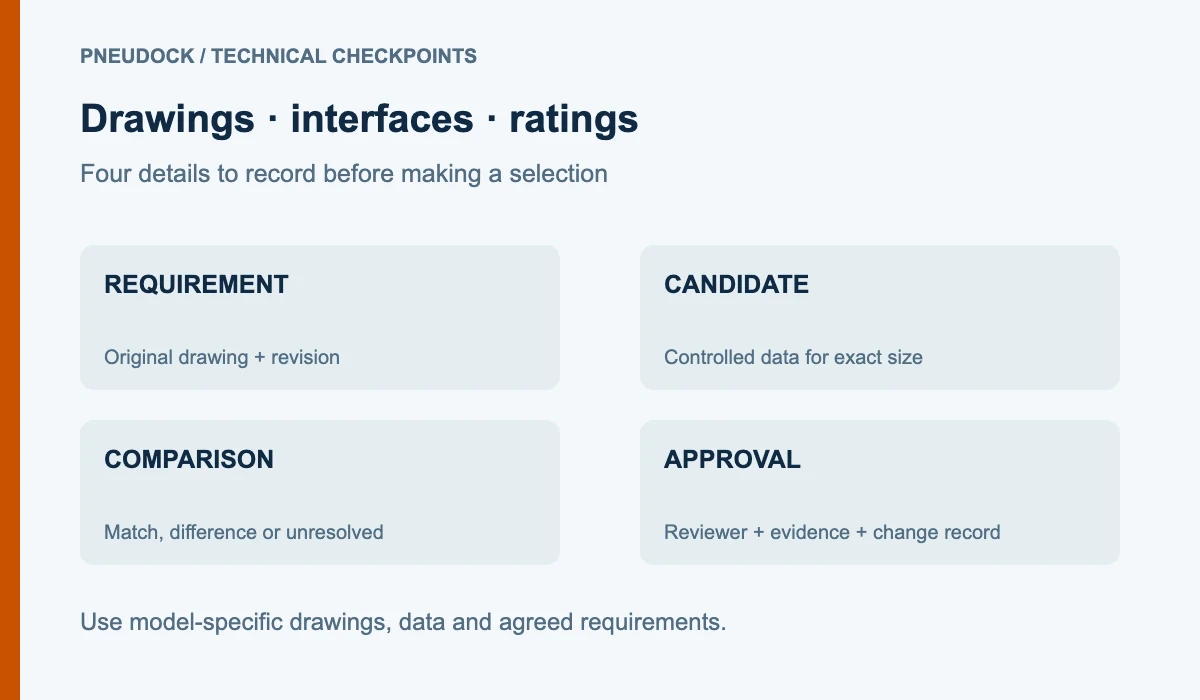
Compare evidence in four groups
A useful pneumatic replacement fitting drawing comparison puts the original requirement and proposed item side by side. Manufacturer catalogues commonly provide drawings, dimension tables, connection details, materials, and rated conditions. Compare the exact series and size rather than borrowing data from a visually similar family.
1. Connections and sealing interfaces
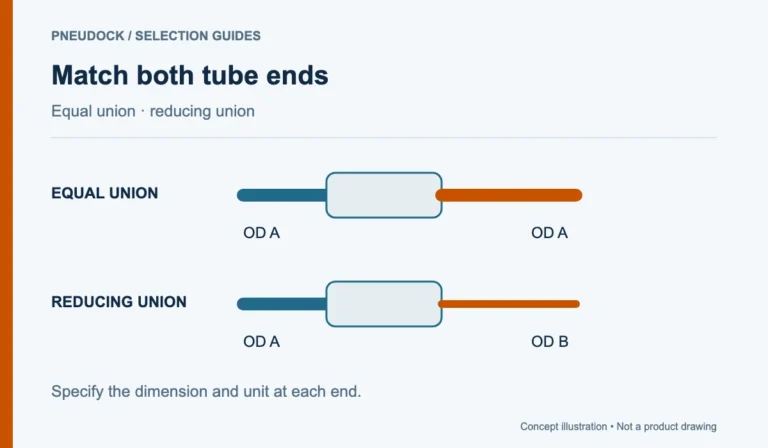
- Tube outside diameter, unit, permitted tube material, and preparation requirements
- Thread standard, nominal size, pitch where relevant, parallel or tapered form, and gender
- Seal location and method, including any required gasket, sealing washer, or approved thread sealant
- Port count, flow direction, and any adjustment or check-valve function
2. Form and installation envelope
- Overall length, body diameter, hex size, tube insertion depth, and elbow or branch orientation
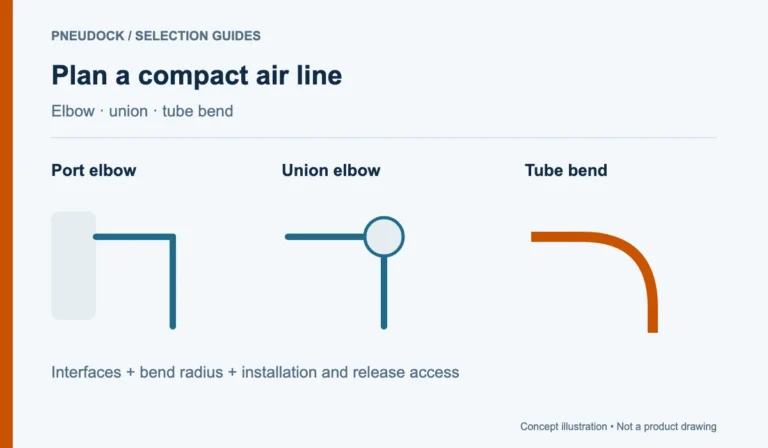
- Clearance for a spanner, release collar, tube removal, and future maintenance
- Mounting or panel features that must align with the existing assembly
3. Materials and service
Compare the body, release components, seals, and any wetted materials against the actual fluid and environment. A broad material family name is not enough when the application has a specific chemical, cleaning, corrosion, or temperature requirement. For documentation questions, see the existing guide to stainless pneumatic fitting material information.
4. Ratings and declared conditions
Check working pressure and temperature together, along with the tube and connection conditions stated by the manufacturer. The Parker Legris catalogue, for example, gives series-specific ranges and explicitly notes that maximum pressure and temperature can depend on the tubing. That is evidence for checking the complete assembly, not a rating for an unrelated candidate.
A compact form-fit-function decision table
| Question | Evidence | Decision |
|---|---|---|
| Form | Dimensioned drawing and installation envelope | Fits, differs, or unresolved |
| Fit | Tube and thread specifications plus sealing detail | Matches every interface or reject |
| Function | Flow role, materials, fluid, and pressure-temperature data | Meets the approved requirement or needs review |
| Evidence | Document title, revision, date, and supplier confirmation | Traceable or incomplete |
Illustrative replacement review
Suppose a buyer needs to replace a straight female-thread push-in fitting but only has a partial code and a photograph. The buyer records the tube as 8 mm OD, identifies the mating male port from its controlled drawing, and obtains dimensioned data for both parts. The candidate matches the tube interface but its thread standard remains unspecified. The correct outcome is “not approved yet,” even if the catalogue image looks right. The missing thread evidence must be resolved before sample installation.
For current PneuDock inquiry references, compare the documented configuration of PCF female straight fittings or PL elbow fittings with your controlled requirement. These product pages are inquiry starting points; they do not certify equivalence to another maker’s part.
Air fitting substitution approval checklist
- Freeze the original requirement and identify every unknown.
- Collect current drawings and technical data for the exact original and candidate sizes.
- Record each comparison as match, difference, or unresolved; do not use “similar.”
- Assess whether a difference affects assembly, sealing, flow, maintenance, or service life.
- Obtain the required technical or customer approval before changing the bill of materials.
- Retain the approved documents, reviewer, date, and any sample or inspection conditions.
This process answers how to verify equivalent pneumatic fittings without turning a cross-reference table into an unsupported compatibility claim. A candidate becomes an approved replacement only when the evidence meets the organization’s defined change-control requirements.