

A pneumatic tee vs Y fitting choice should begin with a three-port map. Both forms create a junction, but their tube approach directions and installation envelopes differ. Neither shape by itself guarantees that two downstream branches receive equal airflow. Record the source, both branches, every connection size and the demand on each branch before choosing a fitting.
Map the junction before comparing shapes
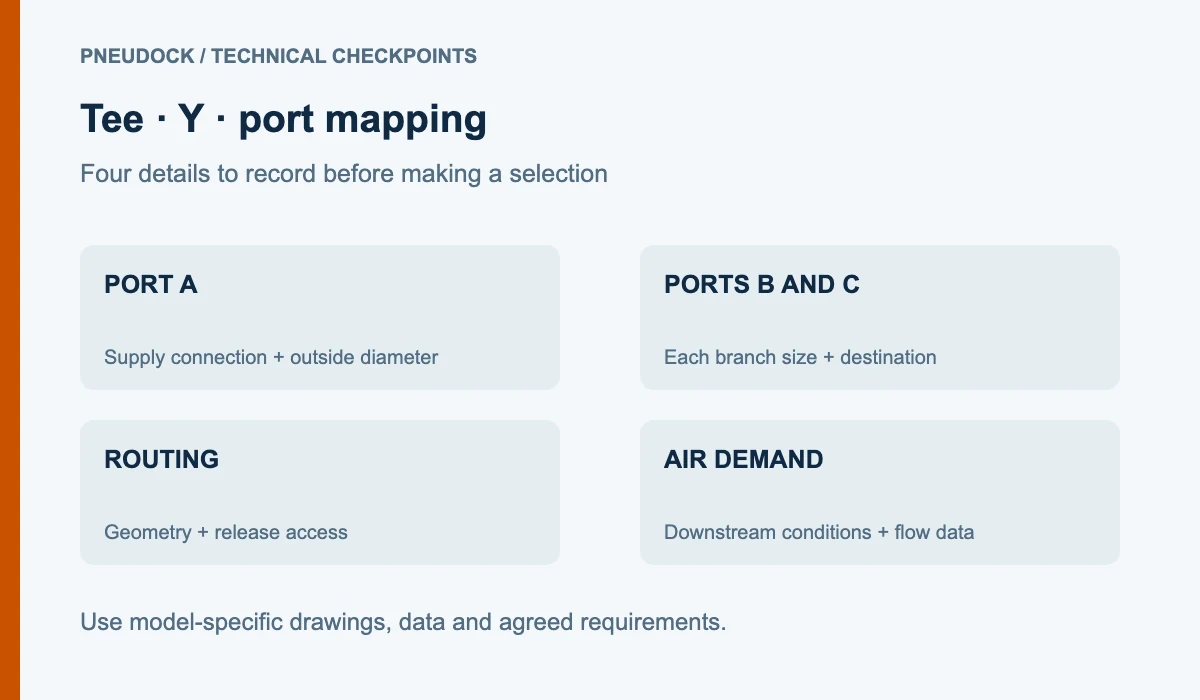
Label the ports S for source, B1 for branch one and B2 for branch two. Then add the connection type and tube outside diameter at all three positions. If any port is threaded, include its full thread standard and size. This three-port map prevents a symmetric-looking body from being mistaken for three identical connections.
PneuDock’s PE stainless tee fittings page asks buyers to provide tube sizes at all three ports, the required stainless grade, seal material, medium, pressure and temperature. Its listed references are inquiry starting points, not proof of the exact port arrangement or performance of a quoted configuration.
| Port | Connection record | Routing record | Demand record |
|---|---|---|---|
| S — source | Tube OD or full thread identity | Approach direction and available straight run | Available pressure and required upstream flow |
| B1 — branch one | Tube OD or full thread identity | Direction, length and access constraints | Device demand and acceptable pressure at use |
| B2 — branch two | Tube OD or full thread identity | Direction, length and access constraints | Device demand and acceptable pressure at use |
Compare tee and Y routing geometry
A tee normally presents a straight run with a branch leaving across it, while a Y union sends paths apart at angled approaches. Manufacturer catalogs treat union tees and Y unions as separate fitting forms and provide their own dimension drawings. Choose between them by checking where the tubes must approach, whether the bodies fit the enclosure and whether all release collars remain reachable.
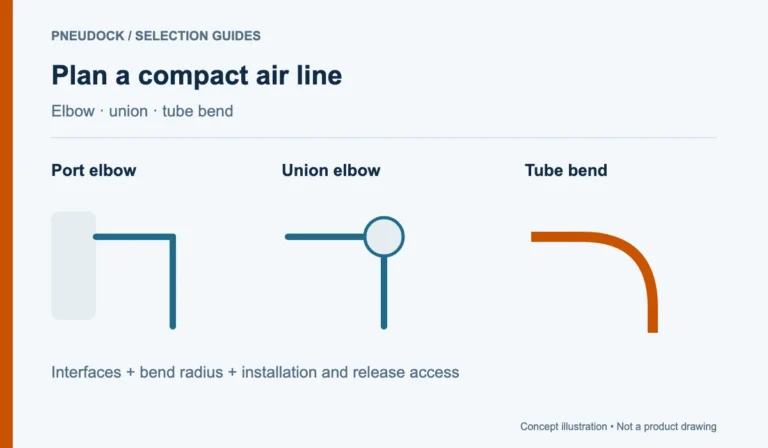
For pneumatic Y union routing clearance, measure the whole installed assembly rather than judging the body alone. Include the tube’s straight insertion length, its permitted bend radius and the hand space needed to disconnect it. A Y may align naturally with two diverging tubes; a tee may align better with a main run and a perpendicular branch. These are layout observations, not universal flow rankings.
Do not infer equal branch flow
A passive three-port junction does not actively divide compressed air into guaranteed equal portions. Compressed air tee branch flow balance depends on the complete paths and loads: downstream restrictions, tube lengths and diameters, valves, device demand, operating pressure and concurrent use all matter. Even two geometrically similar branches can behave differently when their connected devices cycle at different times.
If a process requires controlled or measured distribution, define the required flow and pressure at B1 and B2 and select suitable control or measurement components using their manufacturers’ data. Do not use the tee or Y body shape as the acceptance criterion. The junction still needs adequate ratings and compatible connections, but those checks do not establish a specific split.
Apply the map to an illustrative layout
Illustrative example: one supply tube feeds a clamp on the left and an air-blast valve on the right. The two devices do not have equal demand and may operate at different times. The buyer labels the source and branches, records each tube OD, draws the two approach angles, and provides the operating sequence. A Y may suit the diverging physical route, while a tee may suit a straight trunk with a side takeoff. Either way, branch performance must be checked from the circuit requirements; the example does not state that either fitting provides better or equal flow.
Three-port pneumatic fitting selection checklist
- Identify the source and both destination devices.
- Label S, B1 and B2 on the drawing.
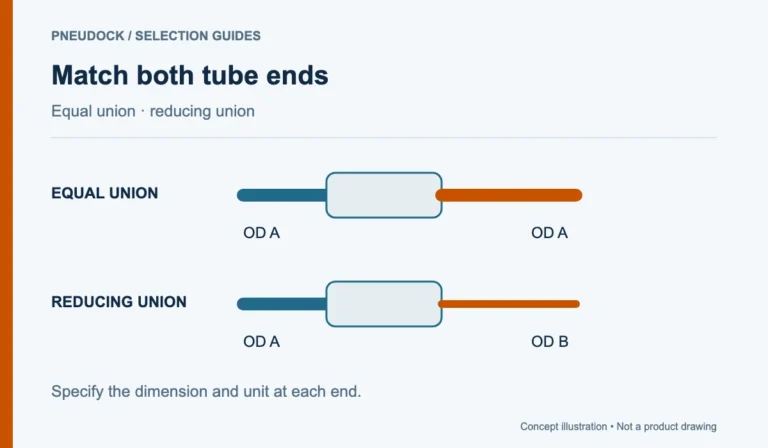
- Record connection type, tube OD and unit at each port.
- Draw the actual tube approach directions and nearby obstructions.
- Allow for insertion length, bend radius and release-collar access.
- State each branch’s flow and pressure requirement separately.
- Describe whether the branches operate together or at different times.
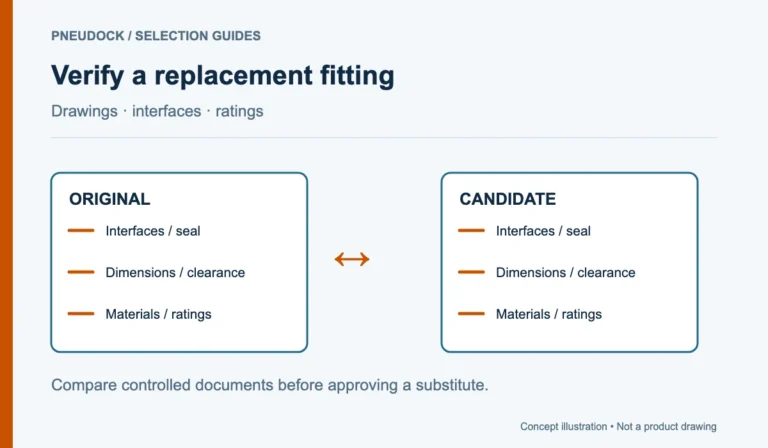
- Confirm material, seals, medium, pressure, temperature and dimensions for the quoted fitting.
The published guide to air line fitting types provides broader identification context. For a purchase request, use the pneumatic parts RFQ checklist to keep models, quantities and units explicit.
Sources
- Parker Legris Master Catalog — identifies union tees and Y unions as distinct fitting forms with separate connection and dimension layouts.