

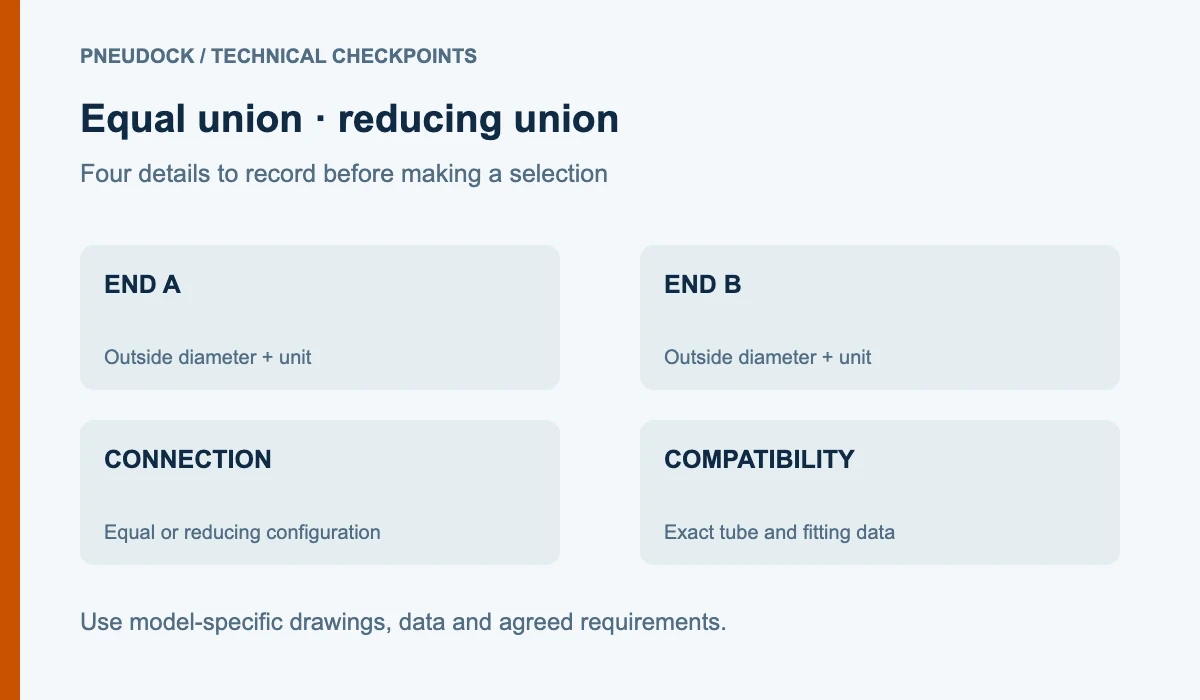
A pneumatic straight union vs reducer comparison is really a two-end mapping exercise. An equal straight union connects tubes with the same specified outside diameter at both ends. A reducing union connects different specified tube ODs. Before choosing either, label the two ends, record each OD with its unit and confirm that both tubes suit the fitting and the operating conditions.
Equal and reducing unions solve different size maps
An equal union is commonly listed by one tube diameter because the same connection size applies at both ports. A reducing or unequal union needs two size entries, often shown as ØD1 and ØD2 in a manufacturer catalog. The order of those entries should be checked against the drawing rather than inferred from the model code.
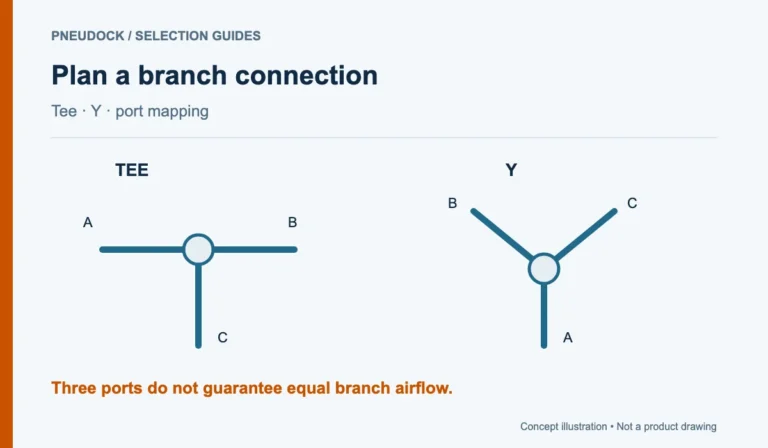
PneuDock’s PU straight push-in unions are in-line, tube-to-tube fittings with push-in ports at both ends. The page currently lists PU6 and PU10 inquiry references. It does not establish that those references are reducers or that every size combination is available. Send the tube outside diameter at both ends and request confirmation for the exact configuration.
| Field | End A | End B | Decision use |
|---|---|---|---|
| Tube outside diameter | Measured or documented OD | Measured or documented OD | Same values suggest an equal union; different values require a reducing connection |
| Unit | mm or inch | mm or inch | Prevents a nominal-number match from being mistaken for a dimensional match |
| Tube identification | Material and part number | Material and part number | Allows the supplier to check tube and fitting suitability |
| Operating conditions | Medium, pressure, temperature and installation environment | Supports confirmation of the complete connection, not size alone | |
Use outside diameter, not an unlabeled nominal size
For a pneumatic reducer, state the tube outside diameter at each end and label what is being measured. Push-in pneumatic fittings are normally selected around the tube OD named by the fitting manufacturer. An inside diameter, hose nominal bore or approximate caliper reading does not replace that value. If the tube marking is legible, preserve the manufacturer and part number in the inquiry as additional evidence.
The published pneumatic tubing size information guide explains the RFQ details to collect. For an existing assembly, the pneumatic fitting model-code guide also helps separate a useful reference from a fully verified specification.
Do not mix metric and inch sizes by appearance
For metric and inch pneumatic tube connections, write the unit beside every value: for example, “End A: 8 mm OD” and “End B: 1/4 in OD.” A conversion calculation can help compare the numbers, but it does not make the tubes interchangeable. The fitting port must be specified for the tube dimension and tolerance recognized by its manufacturer.
Do not treat close-looking values as equal. Also avoid assuming that the larger number is always End A or that a reducing union has a preferred flow direction; verify the manufacturer’s drawing and instructions. If two unit systems meet in one assembly, a deliberately specified adapter removes ambiguity and allows both interfaces to be checked.
Work through a two-end example
Illustrative example: a buyer needs to join an 8 mm OD tube from a manifold area to a 6 mm OD tube leading into a compact device. The required map is “A = 8 mm OD, B = 6 mm OD,” so an equal 8 mm union or an equal 6 mm union cannot satisfy both interfaces. The buyer requests a reducing union whose drawing identifies both tube ports, then checks the allowed tube types and operating limits. The sizes illustrate the method and do not claim that a particular PneuDock model or size combination is available.
Pneumatic union connection size selection checklist
- Name the fitting form: straight tube-to-tube union.
- Label the physical ends A and B on a sketch or photograph.
- Record the actual tube OD and unit at each end.
- State whether the map is equal or reducing.
- Include tube material and any readable part numbers.
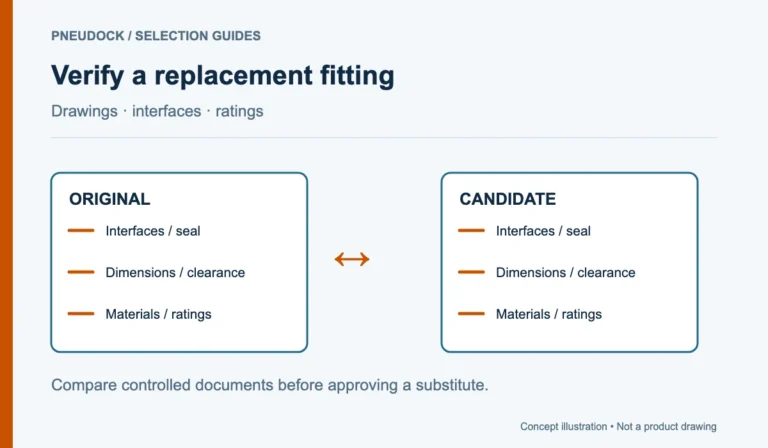
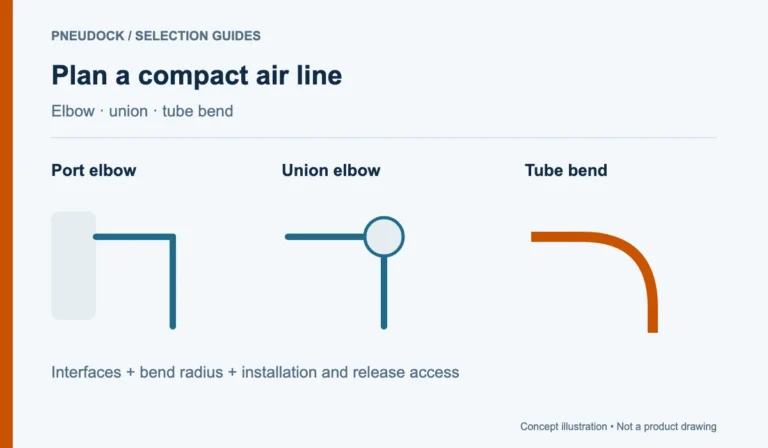
- Check the drawing for ØD1/ØD2 orientation and overall envelope.
- Confirm medium, working pressure, temperature and environmental conditions.
- Request written confirmation of dimensions, materials, fit and supply conditions for the quoted item.
This process keeps equal and reducing unions distinct and turns a vague size request into a reviewable two-end specification.
Sources
- Parker Legris Master Catalog — catalogs equal straight unions by a single tube diameter and unequal unions/reducers by two tube diameters.