

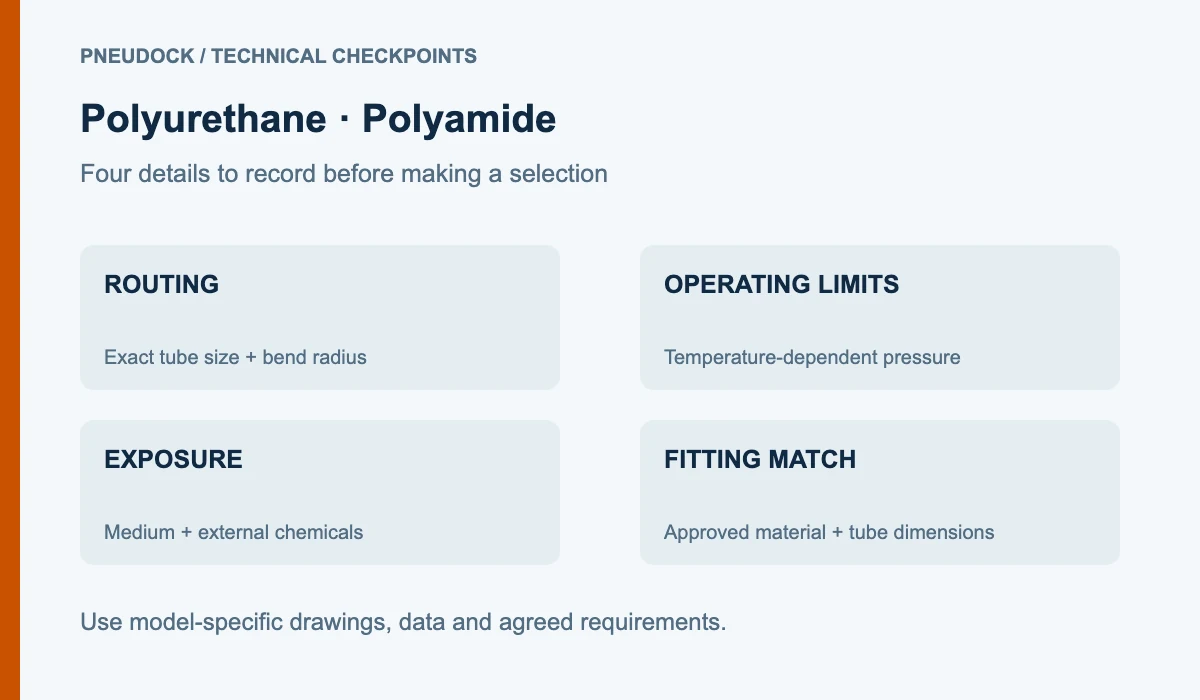
When comparing polyurethane vs nylon pneumatic tubing, start with the application’s routing, temperature, pressure and exposure requirements. Polyurethane tubing is often chosen for flexibility; polyamide tubing, commonly called nylon tubing, offers different pressure-temperature and mechanical characteristics. The exact grade and dimensions determine whether either option is suitable.
Two tubes with the same outside diameter can have different wall thicknesses, materials and operating limits. Colour and apparent softness are not substitutes for the manufacturer’s specification.
Pneumatic tubing material selection guide
Festo describes polyurethane tubes as flexible with small bending radii and contrasts them with more rigid polyamide options suited to different pressure and temperature requirements. These are useful starting distinctions within its product range, not universal ratings for every PU or nylon tube.
| Requirement | Polyurethane candidate | Polyamide candidate |
|---|---|---|
| Tight routing | Check the specified minimum bend radius | Check whether the planned bend fits the selected grade |
| Pressure and heat | Read the exact size’s operating envelope | Read the exact size’s operating envelope |
| Movement | Request relevant dynamic-use data | Request relevant dynamic-use data |
| Chemical exposure | Confirm compatibility with the actual substances | Confirm compatibility with the actual substances |
| Fitting connection | Verify tube material and dimensions are permitted | Verify tube material and dimensions are permitted |
Specify the material grade rather than writing only “PU” or “nylon.” Antistatic, hydrolysis-resistant and other specialist variants require their own documented selection. A property available in one manufacturer’s variant should not be assumed for a standard tube bearing the same base polymer name.
Compressed air tube bend radius comparison
Compare the listed minimum bend radius for each exact tube size. Also distinguish a static installation from a tube that bends repeatedly during machine operation. A route that fits once does not establish its suitability for continuous movement.
Sketch the proposed path between the connection points and identify where clamps, moving assemblies and nearby edges constrain it. Leave room for straight entry into the fitting where the installation instructions require it. If the route cannot satisfy the selected tubing’s requirements, revise the route or connection arrangement before ordering a more flexible-looking material.
Pneumatic tubing temperature and pressure limits
Read the pressure rating together with temperature and tube dimensions. Festo’s tubing overview separates materials and application combinations; it does not give one interchangeable rating for all plastic tubing. Obtain the relevant datasheet and any temperature-dependent pressure information for the proposed item.
Record the normal operating temperature and the highest relevant ambient or medium temperature. Identify whether an exposed section is close to a heat source. Ask the supplier to confirm suitability at the stated condition, rather than comparing maximum pressure and maximum temperature as if both necessarily apply together.
Pneumatic tube chemical compatibility checks
List substances that can contact either side of the tube: the compressed-air medium and any associated treatment, external cleaning agents, oils or process chemicals. Supply the concentration and temperature where relevant. Use a documented compatibility assessment for the specific material grade.
Keep unusual requirements explicit. Food-contact documentation, flame performance, outdoor exposure and electrical properties each need their own evidence when they matter to the application. A general-purpose material description is not a certificate for those uses.
An illustrative material decision
A machine builder needs a short flexible connection in a crowded enclosure and a longer fixed line near a warmer area. The builder treats them as separate requirements, supplies the routing and service conditions for each, and compares suitable grades. Selecting one polymer for the whole machine solely to simplify the purchasing list could hide an important difference between those locations.
PneuDock’s pneumatic tubing references are an inquiry starting point. Confirm material, dimensions and operating conditions for the proposed supply. For recording OD, ID, length and packaging, use the separate pneumatic tubing size information guide.
Technical references
- Festo: Pneumatic tubes — manufacturer discussion of PU and PA characteristics.
- Festo: Overview of plastic tubing and additional information — application and tubing/fitting combinations. These examples do not establish ratings for a PneuDock tube.