

Complete pneumatic tubing size information includes more than the two numbers printed beside a product. Preserve the original size expression, identify what each dimension measures, and state the required length and its unit separately. Material and operating requirements also need confirmation for the selected tubing.
A list entry such as “8 × 5” is useful evidence, but it is not self-explanatory when the column headings, units or source document are missing. Do not let a spreadsheet import or an assumed naming convention turn an incomplete entry into a finished specification.
Keep the Original Size Expression
Copy the original expression, model and source reference into your request before normalising its format. Keep an image or document reference that shows the relevant headings. An asterisk, multiplication sign or slash may be part of the supplier’s notation; preserve it until the intended meaning is clear.
The PneuDock tubing reference list preserves paired size expressions such as 8*5 and asks buyers to confirm their dimension meanings, material and units.1 The correct action is to retain the values and request clarification, not infer missing information from another manufacturer’s table.
Pneumatic Tubing Outside Diameter and Inside Diameter
Record pneumatic tubing outside diameter (O.D.) and pneumatic tubing inside diameter (I.D.) as separate fields with their units. Outside diameter describes the tube’s external size; inside diameter describes its bore.
Pneumatic Tubing Inside Diameter and Wall Thickness
Where a tube specification defines concentric outside and inside diameters, nominal wall thickness follows from those dimensions:
Wall thickness = (outside diameter − inside diameter) ÷ 2.
This is a dimensional relationship, not a way to calculate a safe operating pressure or establish material suitability.
A named external example makes the distinction clear. SMC’s TU/TIUB catalogue lists separate O.D. and I.D. fields; its TU0805 entry gives 8 mm O.D. and 5 mm I.D.2 For that documented SMC example, the tube has an 8 mm O.D. and a 5 mm I.D., giving a nominal geometric wall thickness of 1.5 mm. This SMC example does not specify PneuDock tubing.

The same catalogue separates metric and inch-size entries and shows roll-length information independently.2 Keep those distinctions in your request instead of combining diameter and packaging into a single “size” field.
Metric and Inch Pneumatic Tubing: Keep Sizes Separate
For metric and inch pneumatic tubing, record the measurement system before comparing sizes. For a push-in tube port, record the pneumatic tubing outside diameter required by the fitting documentation. A fitting’s threaded-port designation identifies a different interface; do not copy it into the tube-diameter field.
Ask yourself which object each number describes: the tube outside surface, the internal bore, a mating port or the required purchase length. If the answer is unclear, mark the field unresolved.
Near-looking metric and inch values should not be rounded into interchangeability. For example, converting a quarter inch gives 6.35 mm; that arithmetic does not prove that a 6 mm tube and a nominal quarter-inch tube can be substituted. Keep metric and inch pneumatic tubing as separate requirements until the selected fitting documentation confirms the appropriate tube specification. SMC’s one-touch fitting precautions, for example, call out tubing O.D. accuracy and material; those instructions apply to the SMC components described in that manual.3
Can metric and inch pneumatic tubing be matched by calliper measurement?
Not by measurement alone. Record calliper readings as observations and verify them against current documentation, especially when the sample is worn or distorted.
PU the Fitting Series Is Not PU Tubing
On the PneuDock product page, PU straight unions refer to the PU6 and PU10 connector models, not to coils of tubing or a declaration that the connector body is polyurethane. Record a tube’s material independently of the fitting-series name.
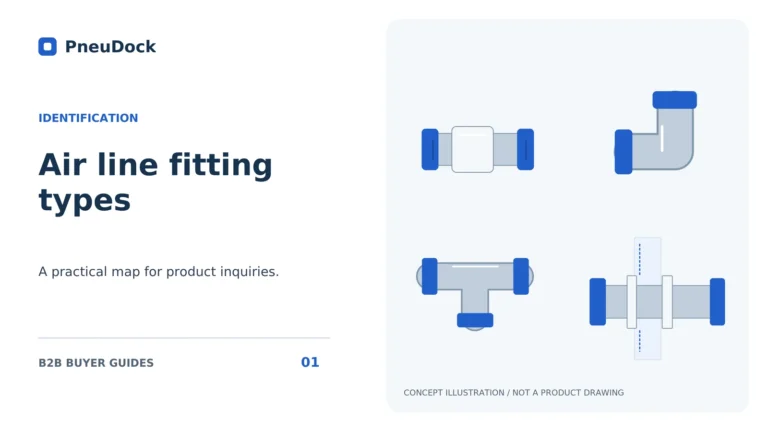
The same separation is useful across common fitting arrangements:
| Fitting reference | Information about the tube | Additional connection information |
|---|---|---|
| In-line tube union, such as the PU series | Tube outside diameter and permitted tube specification at both ends | In-line connection and available space |
| Tube-to-tube elbow, such as the PV series | Tube outside diameter and permitted specification at both ends | Right-angle routing and clearance |
| Female-thread push-in tube connector, such as the PCF series | Tube outside diameter and permitted specification at the tube port | Complete specification of the mating male thread |
| Male-thread push-in tube connector | Tube outside diameter and permitted specification at the tube port | Complete specification of the mating female-thread port |
These are inquiry fields, not confirmed dimensions or a compatibility table. Verify each model’s tube requirements independently of its code.
For a joint tubing-and-fitting request, keep PV elbow references or PU references on piece-based rows and the tubing requirement on a separate length-based row. Ask for confirmation of their combination rather than assuming every tube under Tubing fits every item under Fittings.
Pneumatic Tubing Length Units, Material and Packaging
Pneumatic tubing length units deserve their own fields. Record the total amount required, the preferred continuous length and any acceptable division into pieces or coils. “One roll” is not a fixed length across suppliers or product families.
Our suggested format is:
| Field | What belongs here |
|---|---|
| Original model/size | Supplier’s complete expression and source |
| Pneumatic tubing outside diameter | O.D. value, unit, tolerance and supporting source |
| Pneumatic tubing inside diameter | I.D. value, unit and supporting source; mark unknown values unresolved |
| Material requirement | Actual project requirement or unresolved material question |
| Total requested length | Number and unit |
| Continuous length | Required length per uninterrupted piece, if relevant |
| Packaging | Preferred reel/coil arrangement, or request a proposal |
| Operating conditions | Relevant project requirements for technical confirmation |
| Evidence | Current data sheet and revision |
Do not use colour alone to identify material. Treat colour as its own preference or identification field. Similarly, a common material name does not establish a particular pressure, temperature, bend or media limit for every product carrying that name.
Pneumatic Tubing Size Information: Length Example
Hypothetical demand: a buyer needs 120 metres in total and also requires each working run to be at least 15 metres without a joint.
An offer of 120 separate one-metre pieces meets the total but fails the continuous-length requirement. State both fields and ask for the packing arrangement. These hypothetical values are not PneuDock stock lengths or minimum order quantities.
For a coil-based quote, confirm the length per coil and resulting total before comparing it with your requirement. Do not reuse a previous order’s roll length without checking.
Pneumatic Tubing Size Information: Prepare the Inquiry
Organise pneumatic tubing dimensions and purchasing quantities into a record the recipient can answer directly. Use the published pneumatic parts RFQ checklist for a row format, keeping pneumatic tubing length units and unresolved dimensions in separate fields.
A concise request might read:
Please review the tubing specification attached to this row. The original model and size notation are preserved. Confirm the dimension meanings, units, material and applicable specifications. Our total length and minimum continuous length requirements are listed separately; please state the proposed packing arrangement.
If the tube must mate with an existing fitting, include that fitting’s identity and instructions. Do not present a supplier’s proposed tubing as a confirmed match until the relevant requirements are checked.
Buyer Questions
How should I record pneumatic tubing inside diameter?
Identify the bore dimension and its unit from the source headings. An isolated “8 × 5” string does not establish which value is the bore or whether the units are millimetres; ask for confirmation.
Can I copy another tube’s pressure rating when its diameters are the same?
No. This guide establishes dimensional meaning only. Use the chosen tube’s documented operating conditions and any application-specific requirements.
Is the number of rolls enough for an RFQ?
State pneumatic tubing length units, the confirmed length per roll and any minimum continuous length. A roll count alone leaves the total quantity unresolved.
Take the Next Step
Use the tubing group in Pneumatic Product Series, then Start Your Inquiry with your pneumatic tubing size information: the full size expression, supporting document, material requirement, total length and units. For an existing leaking connection, read the leaking push-to-connect fitting information guide rather than substituting a guessed tube size.
Sources and Scope
-
PneuDock, Pneumatic Tubing, original inquiry references and dimensions, units, material and length confirmation requirements.
-
SMC, TU/TIUB polyurethane tubing catalogue, PDF page 1, printed page 682. This official copy confirms the TU0805 diameter fields and separate metric/inch and packing fields used in the retained example. No PneuDock rating or identity is inferred from it.
-
SMC, ASD-A operation manual, printed page 7, one-touch fitting precautions concerning tubing O.D. and material. Used as a manufacturer-specific example; these are not PneuDock tolerances or compatibility approvals.