

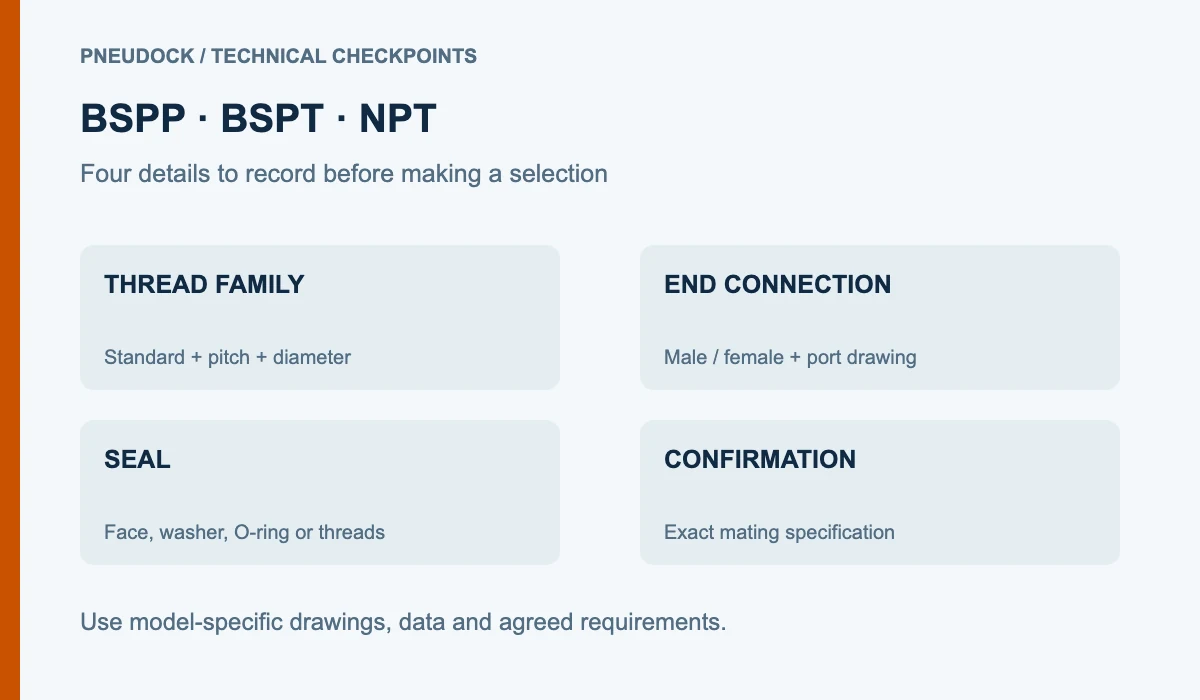
For BSPP vs BSPT vs NPT pneumatic fittings, identify the thread family and sealing interface before choosing a nominal size. A fitting that starts to screw into a port has not yet been shown to be compatible. The useful purchasing description includes the standard, size, male or female connection, and how the assembled joint seals.
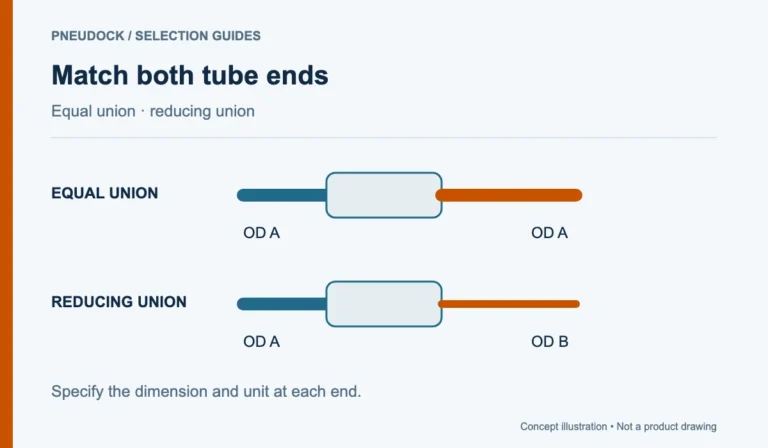
This guide addresses the threaded side of a pneumatic connection. The tube side needs its own outside-diameter specification. Keep these two interfaces on separate lines when recording an unknown part.
Parallel vs tapered air fitting threads
BSPP has parallel threads. BSPT and NPT are tapered thread families, but they have different thread forms. Swagelok’s identification guide treats thread geometry and the complete end connection as separate checks: identifying a thread alone does not identify every feature needed for a sealed assembly.
| Family | Thread shape | Sealing question |
|---|---|---|
| BSPP | Parallel | Which specified face, washer, O-ring or seat forms the seal? |
| BSPT | Tapered | Which mating port and thread-sealing instructions apply? |
| NPT | Tapered | Which mating port and approved sealant or pre-applied seal apply? |
This is an identification summary, not an assembly instruction. Follow the exact fitting manufacturer’s requirements for mating-port form, sealing components, preparation and tightening.
How to identify pneumatic port threads
If you need to know how to identify pneumatic port threads, start with the machine drawing, original part number or port marking. Where those records are missing, have a competent person document the accessible thread after the equipment has been safely isolated and depressurized. Do not loosen a live connection to obtain a measurement.
- Photograph the part, port and any markings before separating identification records from their components.
- Record whether the connection is male or female and whether its diameter appears constant or tapered.
- Measure diameter and pitch with appropriate tools, retaining the measured values rather than turning them immediately into a guessed nominal size.
- Compare the measurements with the relevant manufacturer’s identification table.
- Document the sealing face, seat or seal and seek confirmation of the complete mating connection.
Swagelok notes that some BSPT and NPT connections are difficult to distinguish. An uncertain measurement should remain an open identification question. Increasing tightening force is not an identification method.
Pneumatic thread sealing methods belong to the connection
Parker’s push-to-connect reference describes different pneumatic thread sealing methods. A parallel-thread connection may use a separate seal, while a tapered-thread connection can seal at the threads. Record where the original joint seals alongside its apparent diameter.
For a parallel port, ask for the specified sealing arrangement and any required port-face geometry. For a tapered connection, ask whether the exact fitting is supplied with a sealing treatment and what installation procedure applies. Avoid prescribing a generic number of tape wraps or turns across unrelated products. Record whether a replacement seal is included in the quotation when one is required.
BSP and NPT fitting compatibility: an inquiry example
Illustrative example: a maintenance list says “8 mm tube × 1/4 elbow.” That describes a tube size, nominal thread size and shape, but leaves the thread family unresolved. The buyer sends a drawing of the receiving port and asks the supplier to confirm the mating thread and seal. The buyer treats BSP and NPT fitting compatibility as unresolved until the supplier confirms the complete mating connection. Two catalogue entries marked “1/4” still need separate thread and seal checks.
The same discipline applies to a straight connection. PneuDock’s PCF female straight fittings provide a starting series reference. A model suffix alone does not establish the complete mating-thread specification. If your main question is interpreting a source code, use the separate pneumatic fitting model-code guide.
Send a connection record that can be checked
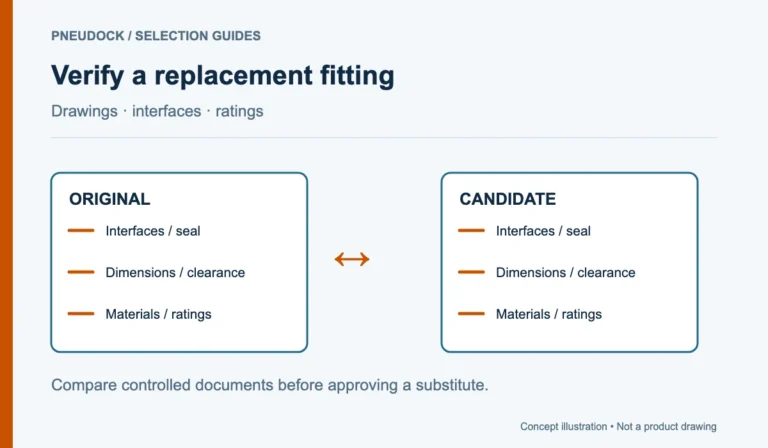
Include the port drawing or marking, original reference, tube outside diameter, measured thread information and service conditions. Identify each unanswered item explicitly. Ask for the supplier’s model-specific drawing and installation instructions with the proposed replacement. That creates a traceable decision instead of a trial assembly based on appearance.
Technical references
- Swagelok: Thread and End Connection Identification Guide — identification sequence, thread families and limits of visual identification.
- Parker: Push-to-Connect Fittings — practical thread and sealing information. Manufacturer examples do not certify the specifications of a PneuDock product.